

In one of my recent posts, I talked about umpiring and the unique aspect of golf being a self-refereed sport.
In a Stableford or two-ball scramble match, this self-refereeing is checked and verified by the other players or teams in the same group. We swap scorecards and check the scores at the end.
Last week, I took part in a four-ball scramble competition. In over 20 years of playing golf, I believe this is only the third time I’ve played in a four-ball scramble.
This format represents the very essence of self-refereeing in golf. There is, in fact, no score verification; the scorecard is filled in by the team, who are on their own during the round, and handed in to the organising committee, who must place absolute trust in the team’s honesty.
I played with three Brits whom I didn’t know before the round – two Englishmen and a Scotsman, all three of whom were very friendly. To say the least, we didn’t perform very well, as we only handed in a card of -1 at the end of the 18 holes.
The winning team shot -11, a rather remarkable score.
This scramble had a particular rule that I’d never come across before. According to my partners, however, it’s common in Britain:
The team is free to choose the ball they consider the best for each shot—obviously, as is always the case in a scramble—except that for the scorecard to be valid, by the end of the 18-hole round, each player must have been selected to take the tee shot at least four times.
My partners took this very seriously, to the point that at one stage, after a tee shot, they stopped to discuss at length how many times each player had been chosen, whilst the group behind us was already teeing off.
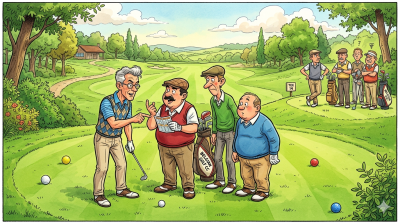
I understand the idea behind it, so that the player who tees off the least well doesn’t feel frustrated. On the other hand, if one of the players hits all their drives into the trees, it’s not great. And there’s not much they can do about it if they’re having a bad day. It didn’t happen that day, thank goodness.
As I mentioned, this round gave me the chance to get to know these three Brits, particularly one of them, Jan, with whom I chatted a lot during the round and also afterwards in a very friendly manner. A charming man, but exactly the sort of golfer I can’t stand.
Apparent contradiction?
As I’ve explained in other posts, one goal I’ve been pursuing (from a distance, alas) for over 20 years in golf is to have a smooth, fluid swing. I’m aware that I’m not very supple or very elegant when I play, and for years I’ve been trying to improve that; I also try to achieve beautiful trajectories, with high, straight shots.
This quest is more important to me than my scorecard.
But still, if I could manage to achieve good scores with beautiful form, that would be the Holy Grail.
Jan couldn’t care less about that sort of goal. For him, only the result counts.
He is a man who is quite significantly overweight, who doesn’t seem very flexible and, to put it mildly, isn’t very athletic.
He has a swing that could be described as truly awkward.

He turns completely to the left and hits big-slicing shots, which he uses to perfection to get back to the middle of the fairway, with good distance.

His approach technique is aesthetically of the same ilk, minus the slice.
So you can understand why I can’t help but ‘hate’ this type of player who succeeds perfectly where I fail to perform, whilst executing moves that you wouldn’t see taught in any golf school. It’s frustrating at times.
Nevertheless, I’ll happily play with him again soon.
This is yet another fine lesson in the sport. There’s room for everyone, whatever your build, age or style.
The important thing is to enjoy playing and sharing the experience.